4626 West Jefferson Blvd. Fort Wayne, Indiana 46804


What’s the Difference Between Dental Crowns & On-lays?
Do you have damaged teeth, and your dentist discussed with you that you’d need restorative treatment? When repairing cracks and breakage on the tooth’s surface, choosing between a dental onlay and a crown is sometimes tricky. These dental restorations are used to restore a tooth’s natural appearance and functionality. This article compares the on-lay and crown and how they are used to restore teeth.
Dental Crowns vs. On-lays: Key Differences Explained
What is a dental on-lay?
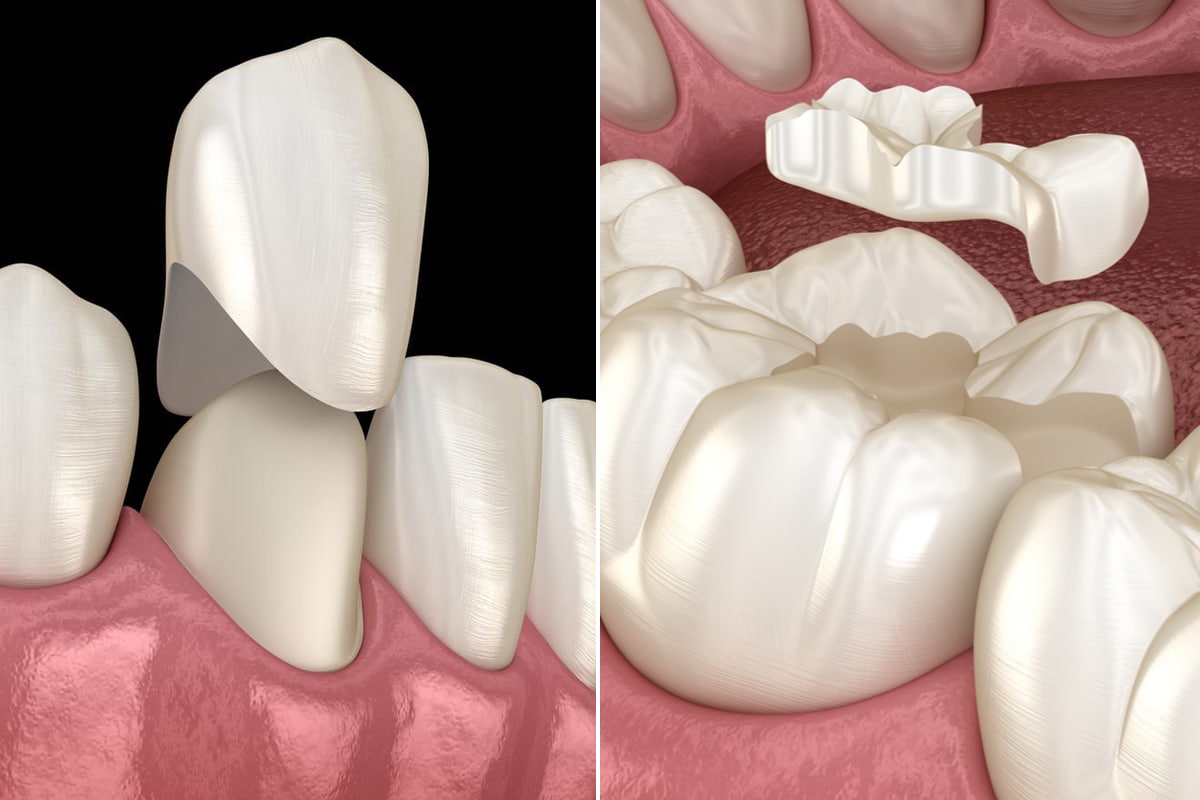
A dental on-lay is a piece of porcelain that covers a portion of a tooth and is bonded to it. An on-lay should be used if the cusps of the tooth are damaged. Afterward, the dentist will remove the decayed or damaged piece of the tooth and take impressions to make a new one. When the on-lay is installed, it is supposed to blend in with the rest of the tooth. A crown-like restoration, an on-lay, entails removing only a small amount of tooth structure, hence known as a partial crown.
Although onlays don’t offer the same protection as dental crowns, they nevertheless have a number of advantages over such restorations. Because of significant decay or excessive fillings, a tooth’s structure can change. When damage is too significant for a filling but not extensive enough for a crown, a dental onlay may be the best option.
What is a dental crown?
A dental crown entirely encases the tooth structure with porcelain or ceramic. It is necessary when more than half of the tooth’s occlusal or entire biting surface is damaged. An on-lay, inlay, or filling can be replaced with a crown after it’s been damaged again; however, the size of a crown can cause a structural problem with the tooth.
During the initial preparation of the crown, a dental impression is taken of the teeth. To complete the procedure, a crown is created from a mold of the patient’s natural teeth. After that, the crown can be affixed to the tooth with cement.
For aesthetic reasons, a dentist rarely uses a crown unless the tooth has been injured by teeth grinding. Dental crowns are worthwhile only if they are used for other goals, such as restoring teeth to their natural shape or boosting their strength. Crowns are sturdy and long-lasting, but the main problem is that a large section of the enamel must be shaved off to fit them.
On-lay vs. Crown: How Long Would It Last
Your actions matter. With good quality production and proper care, dental crowns can last from five to a decade. The same goes for onlays, which can endure at least ten years with good oral hygiene. Remember, your habits and care play a significant role in the success of these restorations.
For the best results from onlays and crowns, you must avoid practices that strain the teeth excessively and limit their lifespan. Also, keep in mind that the teeth behind your crown or onlay must be robust and healthy at all times. Removing and replacing the appliance may be necessary if the tooth worsens.
However, some factors, such as the following, could reduce its duration:
- clenching your jaw
- a habit of gnawing on your fingernails
- The teeth or the surrounding area can be damaged by chewing on anything overly complicated or sticky.
Damage to the material from these factors may necessitate immediate repair or replacement.
Factors that can affect price are as follows:
- The location of the tooth in your mouth.
- The extent of the damage.
- If basic restorations are only needed.
- Whether or not additional procedures are required.
- Whether the surgery is necessary or not.
Don’t let cost be a barrier. While the price of dental restorations can vary based on factors like the location of the tooth and the extent of the damage, dental insurance typically covers part of the cost. Whether you choose a crown or an onlay, rest assured that your insurance can help make these treatments more affordable.
On-lays Vs Dental Crowns: Which is best for you?
When a filling or inlay won’t do the trick, you’ll need more extensive single-tooth restorations, which are often reserved for the most severe tooth decay. An onlay covers the tooth’s cusp, whereas an inlay merely covers the region between the tooth’s cusps. Even after the tooth has been drilled, an on-lay can be custom-made to fit the exact dimensions of the void. On the other hand, a crown encircles a patient’s tooth’s biting surface and even some of its structure above the gum line.
When possible, an on-lay is a less invasive restoration than a crown since it necessitates removing less of the natural tooth structure. In terms of price, an on-lay is less expensive than a crown. As a result, an on-lay is the ideal method of repair. On the other hand, a dentist’s ability to do an onlay correctly depends more on the dentist’s skill. Dental insurance covers onlays less commonly than inlays, which is a significant drawback. They will, however, cover a crown, indicating that crowns have gained widespread acceptance among dentists and patients alike.
Read more: Cap vs Crown: Which is Right for You?
Call Family Dentistry & Aesthetics To Learn More About Their Difference
Remember, you’re not alone in this decision. You can always rely on the expertise of your trusted dentist in Fort Wayne. We’re here to guide you and help you make the right decision for your oral health and overall well-being. Thank you for reading!