A Comparative Guide on Dental Bridges Vs. Implants

By Family Dentistry & Aesthetics Inc. | July 27, 2022

A Comparative Guide on Dental Bridges Vs. Implants

Getting a replacement for a missing tooth is critical to keeping your teeth in normal alignment. Replacing missing teeth can help you keep your facial features and avoid eating and speaking challenges. Dental bridges and implants are the two most prevalent alternatives.

However, what’s the difference between these two common tooth replacement options? What’s the difference between a dental bridge procedure and a dental implant procedure? Even while they do the same thing—replacing lost teeth—they do so differently.


Dental Bridges

False teeth that span the tooth gap left by a missing tooth are attached to the surrounding healthy teeth with dental bridges. Dental bridges are still an option for patients who have lost a single tooth or more; however, way back, it was once the only treatment option for closing a tooth gap in your smile. In order to match the color of your natural teeth, they’re commonly manufactured of porcelain or plastic. You can use them to conceal a single lost tooth or a row of teeth.

Dentists use dental bridges to fill up the gaps that occur when a tooth is lost. As a result, your dentist will need to file down one or more nearby teeth to serve as a support for the repair. Implants replace your tooth root, whereas bridges do not. When a tooth is lost, a crown is usually attached to one or more of your neighboring teeth as a buttress. 

Depending on the patient’s demands, a dental bridge can replace one to four teeth. When enough healthy teeth are present, dental crowns can be used to replace more than four teeth in specific circumstances.


Types of Dental Bridges

Dental bridges come in a variety of forms, including:

  • Traditional Dental Bridge: Dental crowns attach false teeth to nearby real teeth.
  • Cantilever Dental Bridge: Only one natural tooth is needed to support a cantilever bridge since the crown of the crowned surrounding teeth is glued into the gap.
  • Implant-Supported Dental Bridge: Instead of crowns or frames, implant-supported bridges use dental implants. Implants are surgically implanted into each missing tooth to support the bridge.
  • Maryland Dental Bridge: A Maryland bridge, like a traditional bridge, comprises two natural teeth, one on either side of the gap left by the missing tooth. A Maryland bridge employs a metal or porcelain framework connected to the backs of the surrounding teeth instead of dental crowns.


Dental Implants

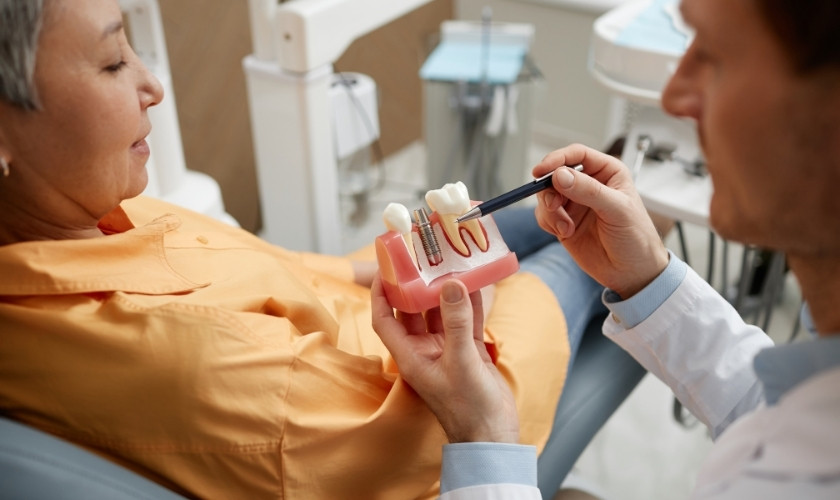
Dental implants may be your best option if you have periodontal disease, an injury, or any other cause for a missing tooth or teeth. A titanium metal cylinder is a tooth root for a dental implant, which holds a crown in place.

The titanium used in dental implants serves as an artificial tooth root. To hold a crown or bridge in place, they are screwed into your jawbone.

Implants are surgically implanted into your jawbone and fused into place, making them a permanent part of your smile. An abutment is attached to the post frame once the fusing procedure is complete. This protrudes over your gum line and provides a location for the dental crown, which is screwed or cemented.


Dental Bridges vs. Dental Implants: Pros and Cons

When it comes to dental implants and bridges, here are some things to keep in mind: To assist you in making an informed decision, we’ll go over the pros and cons of each option.

  • Dental Bridges: Pros
  • B have dental insurance
  • Non-invasive surgery as it doesn’t require bone grafting
  • Typically only takes two visits to your experienced dentist.
  • Usually has a lesser upfront cost.


Dental Bridge: Cons

  • It can’t maintain its natural-looking appearance over the years
  • May harm neighboring teeth around it
  • More susceptible to tooth decay and cavities
  • It should be replaced every 5 to 7 years


Dental Implants: Pros

  • Durable as it can last up to 15 years.
  • Longest-lasting replacement teeth option
  • Do not cause damage to stable teeth around the implant
  • With a 97 percent success rate.


Dental Implant: Cons

  • Usually not covered by insurance companies.
  • Upfront costs are higher
  • May result in surgical issues
  • A six-month time frame is possible for the surgical procedure.


Dental Bridges vs. Dental Implants: Comparing Costs

Dental bridges are generally less expensive than implants, and insurance is more likely to cover at least some of the costs. Depends on the following factors:

  • Whether or not you’re getting an implant or a bridge.
  • What materials are being utilized
  • How lengthy the treatment is.
  • Where you reside.

Low-end dental bridges cost around $500 per tooth, but more expensive bridges can cost as much as $1,200 per tooth. There’s still the cost of the dental crown, which is what secures the tooth to the teeth around it. A dental crown might cost anything from $500 to $2,500.

The average cost of a dental implant is between $3,500 and $4,500. Implants are less likely to be covered by insurance providers. Implants are more expensive up front, but they tend to last longer than bridges and don’t have to be changed frequently.

Read more: Bonding Chipped Tooth: What You Need to Know

 

Call Smile Fort Wayne To Learn More About The Differences Between Dental Bridges and Implants

If you are considering dental bridges or implants, please do not hesitate to contact the most trusted dentist in Fort Wayne. Our team at Smile Fort Wayne is more than happy to answer any questions you may have about the differences between dental bridges and implants and help you determine which option is best for you. We look forward to hearing from you soon!

Related Articles

By Family Dentistry & Aesthetics Inc.