4626 West Jefferson Blvd. Fort Wayne, Indiana 46804


Dental Bridge vs. Implant: Which Treatment Timeline Fits Your Schedule?
Losing a tooth can have a significant impact on both your appearance and your oral health. Whether it’s due to injury, decay, or other dental issues, the best thing is that you have two popular options for tooth replacement: dental implants and dental bridges.
Each solution offers its own benefits and considerations, and understanding these differences can help you make an informed decision about restoring your smile.
In this guide, we’ll explore both implanted teeth and tooth bridges, providing you with important information on pricing, the process, and the factors that influence your choice.
Dental Bridges vs. Dental Implants: What’s the Difference?
Both bridges and implants are designed to replace missing teeth, but they differ in how they restore your smile:
- Dental Bridge: It involves creating a false tooth (pontic) that is anchored in place by crowns on the adjacent natural teeth (abutments). This solution doesn’t require surgery and is often completed in a few visits.
- Dental Implant: It is a surgical procedure in which a titanium post is placed in the jawbone, acting as the root for a replacement tooth (crown). Over time, the implant fuses with the bone, creating a strong, durable solution.
Here’s a quick comparison:
| Feature | Dental Bridge | Dental Implant |
| Procedure | Non-surgical, quicker process | Surgical procedure with healing time |
| Effect on Adjacent Teeth | Requires reshaping neighboring teeth | Does not affect neighboring teeth |
| Jawbone Impact | Does not prevent bone loss | Helps preserve bone structure by stimulating the jawbone |
| Longevity | Lasts around 5-15 years | Can last 15-30+ years |
| Maintenance | Requires special cleaning tools | Maintained like natural teeth |
| Initial Cost | More affordable | Higher upfront cost |
How a Dental Bridge Works
It is an effective solution for replacing one or more missing teeth. The process involves:
- Initial Consultation and Preparation: Your dentist will assess the surrounding teeth (abutments) to ensure they can support the bridge. These teeth may need reshaping to fit the crowns that hold the bridge in place.
- Bridge Creation: Impressions are taken and sent to a dental lab to craft a custom bridge that will match the shape and color of your natural teeth.
- Final Placement: Once the permanent bridge is ready, it’s securely placed, and adjustments are made for comfort and function.
Advantages of Dental Bridges
- Faster Process: It can typically be completed in 2-3 visits over a few weeks, which is faster than the implantation process.
- Non-Surgical: Ideal for patients who prefer not to undergo surgery.
- Lower Initial Cost: They are generally less expensive than implants in Indiana, with prices ranging from $500 to $1,200 per tooth.
Considerations for Dental Bridges
- Impact on Adjacent Teeth: The adjacent teeth need to be reshaped, potentially affecting their structure.
- Bone Loss: Bridges don’t prevent jawbone resorption that occurs when a tooth is missing.
- Shorter Lifespan: Bridges typically last 5-15 years before needing replacement.
How a Dental Implant Works
These restorations provide a more permanent and natural solution to replace missing teeth. Here’s how the process works:
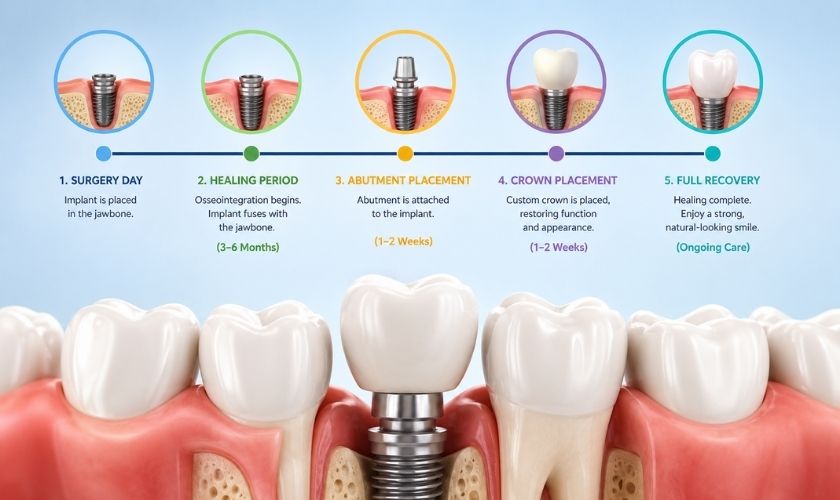
- Surgical Placement: A small titanium post is placed into the jawbone where the tooth root used to be. Over the next several months, the implant integrates with the bone in a process called osseointegration.
- Healing and Integration: The implant becomes a stable foundation for a replacement tooth.
- Crown Placement: Once the implant has fully integrated with the bone, a custom crown is attached to the post, completing the restoration.
Advantages of Dental Implants
- Long-Term Durability: They can last decades with proper care.
- Bone Preservation: The implant stimulates the jawbone, preventing bone loss.
- Natural Feel and Look: Implants function like natural teeth because they are anchored into the jawbone.
Considerations for Dental Implants
- Longer Process: Implants require several months to heal, including osseointegration.
- Higher Initial Cost: They are a larger financial investment, with costs ranging from $1,500 to $3,000 per implant in Indiana.
- Requires Surgery: Implants require a surgical procedure, which involves risks and a longer recovery period.
Cost Comparison: Dental Bridges vs. Dental Implants
When considering tooth replacement options, cost is often a deciding factor. While bridges have a lower initial cost, dental posts offer a longer-lasting solution, making them a good investment over time.
Here’s a comparison of pricing in Indiana:
- Dental Bridges: Typically range from $500 to $1,500 per tooth, depending on the materials used and the complexity of the procedure.
- Dental Implants: The cost of a single implanted tooth in Indiana ranges from $1,500 to $5000, with additional charges for the crown and any preparatory surgeries, if needed.
While bridges may initially cost less, dental posts tend to be a better long-term investment due to their durability and the ability to preserve the bone structure in your jaw.
Treatment Timeline: What to Expect
Dental Bridge Timeline:
- Consultation & Preparation: 1-2 visits
- Temporary Bridge Placement: Immediate
- Final Placement: Typically within 2-3 weeks after impressions are made
Dental Implant Timeline:
- Consultation & Placement: 1 visit
- Healing and Osseointegration: 3-9 months
- Crown Placement: Final restoration after full healing
If you need a quicker solution, a tooth bridge might be your best choice. However, if you’re looking for a more permanent solution and don’t mind waiting, an implant could be the right fit for your long-term needs.
Living in Fort Wayne: Local Factors That Impact Your Choice
Fort Wayne residents live in a city known for its family-friendly atmosphere, vibrant community, and strong sense of local pride. Whether you enjoy attending the Three Rivers Festival or spending time at Foellinger-Freimann Botanical Conservatory, Fort Wayne’s active lifestyle and the regional climate can influence your choice between a bridge and an implant.
For those who enjoy outdoor activities or sports, such as basketball or hiking at Lutheran Park, the durability and bone preservation offered by implants may appeal to those who want a long-lasting solution. Implants are particularly ideal if you’re concerned about the long-term health of your jawbone, as bone loss can affect how your face looks over time.
For residents who need a quicker option and prefer a less invasive procedure, a dental bridge offers a faster route to restoration. The process requires fewer visits and avoids surgery, making it a good choice for people looking to restore their smile more quickly while still getting reliable results.
Explore the Best Tooth Restoration Options at Our Fort Wayne Dental Office
Deciding between a tooth bridge and an implant is an important choice. Visit our dental office to help weigh your options. Each solution has its own set of benefits, and a consultation will guide you in choosing the one that’s best for your oral health and lifestyle.
Ready to Restore Your Confidence- Family Dentistry & Aesthetics Can Help
If you’re in Fort Wayne or the surrounding areas and considering an implant or dental bridge, the first step is to come to our dental office for a consultation. We can guide you through the options, explain the process in detail, and help you make a confident decision based on your needs.
Schedule your appointment today by calling (260) 432-0561, and take the first step toward a healthier, more vibrant smile.
Frequently Asked Questions
1. What is the difference between a dental implant and a dental bridge?
A dental implant involves a titanium post placed in the jawbone, while a dental bridge uses crowns on adjacent teeth to support a false tooth. Implants are a more durable, long-term solution, while bridges are quicker to place. For a detailed consultation, visit your local dental office to explore which option best suits you.
2. How long do dental bridges last compared to implants?
Dental bridges typically last between 5 and 15 years, while implants can last 15 to 30+ years with proper care. Implants offer better long-term value by preserving jawbone health and lasting much longer. Visit your dentist to find out which option fits your needs.
3. Are dental implants a painful procedure?
Although dental implants require surgery, the procedure is done under local anesthesia to ensure you’re comfortable. Post-procedure discomfort is manageable, and many patients find the recovery smoother than anticipated. Consult with a dental professional to discuss what you can expect.
4. Do dental implants require special maintenance?
Dental implants are easy to care for and can be maintained just like natural teeth. Unlike bridges, they don’t require special cleaning tools. For personalized tips on maintaining your implants, schedule a visit with your dentist to get all your questions answered.
5. How long does the dental implant process take?
The dental implant process typically takes several months, including the healing time for osseointegration, during which the implant fuses with the bone. If you’re seeking a permanent solution, it may be worth the wait. Schedule a consultation to learn about the specific timeline for your case.
6. Can I get a dental implant if I have bone loss?
Yes, dental implants can often still be placed even with bone loss, though additional procedures like bone grafting may be necessary. Discuss with your dentist to understand how this might impact your treatment options.
7. What are the benefits of choosing a dental implant over a dental bridge?
Dental implants offer better long-term durability, prevent bone loss, and don’t require altering adjacent teeth, unlike bridges. For a personalized consultation, visit your dentist to discuss the advantages of implants in your specific case.